

RoboticEA Review 2026
Best ValueIn-depth RoboticEA review covering 34 strategy archetypes, per-year validation, the robustness-invariant refiner, bar-by-bar replay and .mq5 export — and why it scored 9.6/10 as the most rigorous no-code EA builder we've tested.
RoboticEA is the most rigorous no-code EA builder we've tested, and its rigour is the point. Anyone can generate strategies; the hard part is throwing away the ones that only worked once, and this is the only tool in the category where per-year validation runs automatically on batch winners and the refiner will flag a higher-scoring variation as FRAGILE rather than promote it. Add real spread, commission and swap charged by default, a fixed $10,000 account so every result is comparable, bar-by-bar replay to see what the worst trade actually looked like, and export as readable .mq5 source rather than a sealed binary, and you have a platform that is unusually hard to fool yourself with. It asks more of the user than a signal service does, and the token metering adds up if you generate in bulk — but if you intend to run a robot on real money, this is the workflow you want in front of it. Second only to ChartSnipe overall, and first by some distance if what you need is a trading robot rather than chart analysis.
Try It →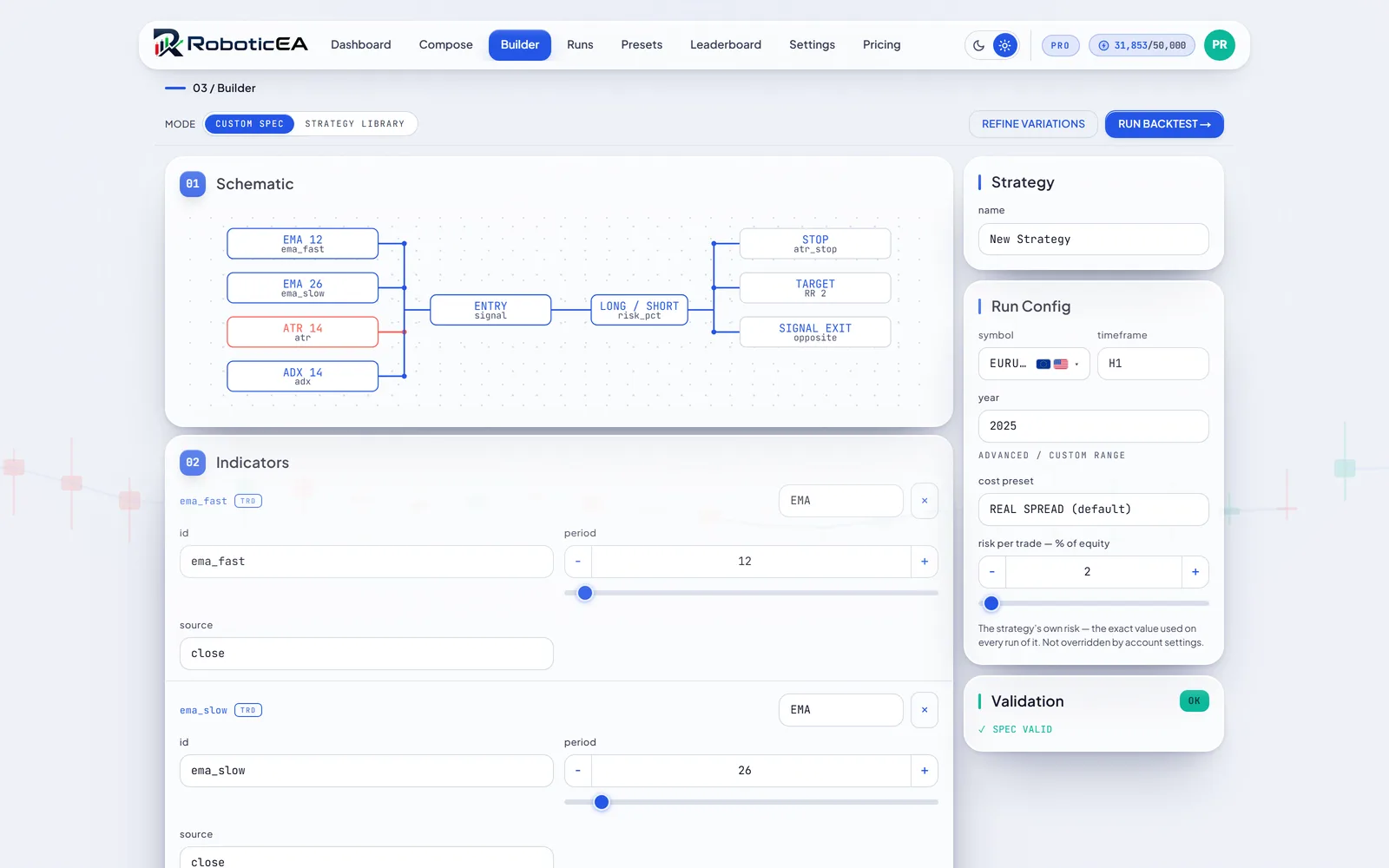
RoboticEA occupies a category almost nobody else serves properly: it is not a signal service and not a sealed robot you rent, but a workbench for building, testing and exporting your own expert advisor without writing a line of MQL5. You compose a strategy, the platform backtests it on real market data, and if it survives you export MetaTrader 5 source code that you compile and run on your own broker.
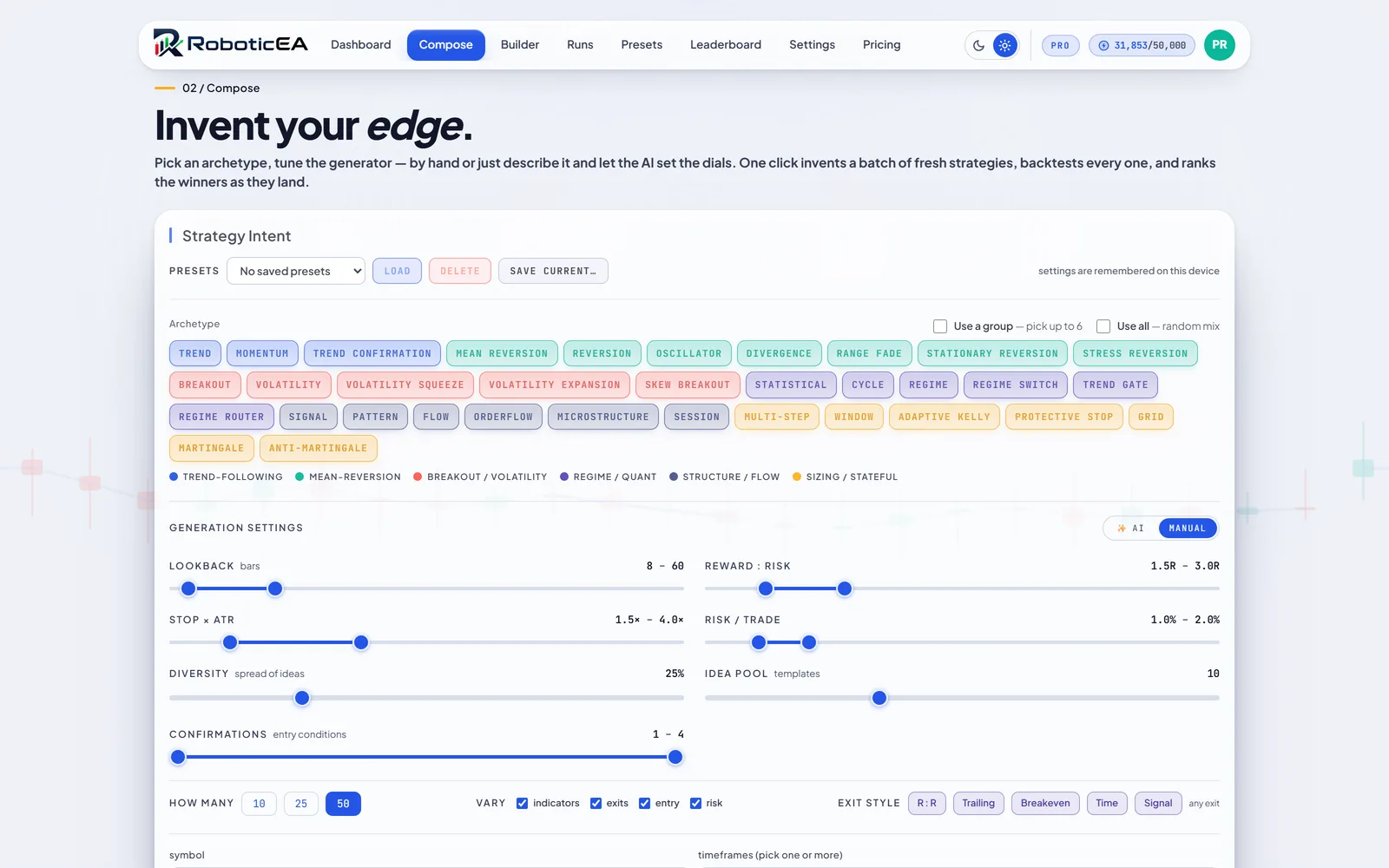
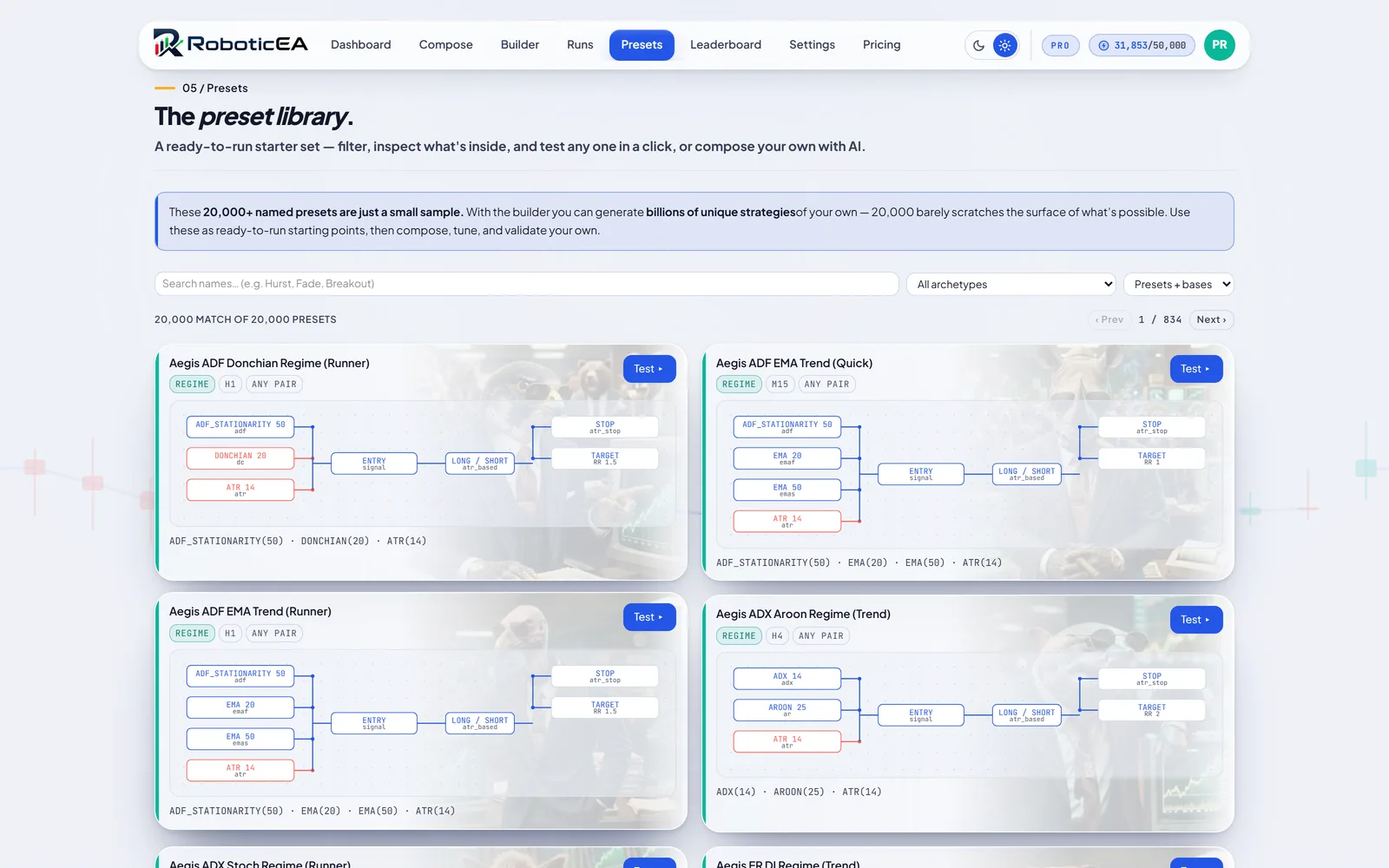
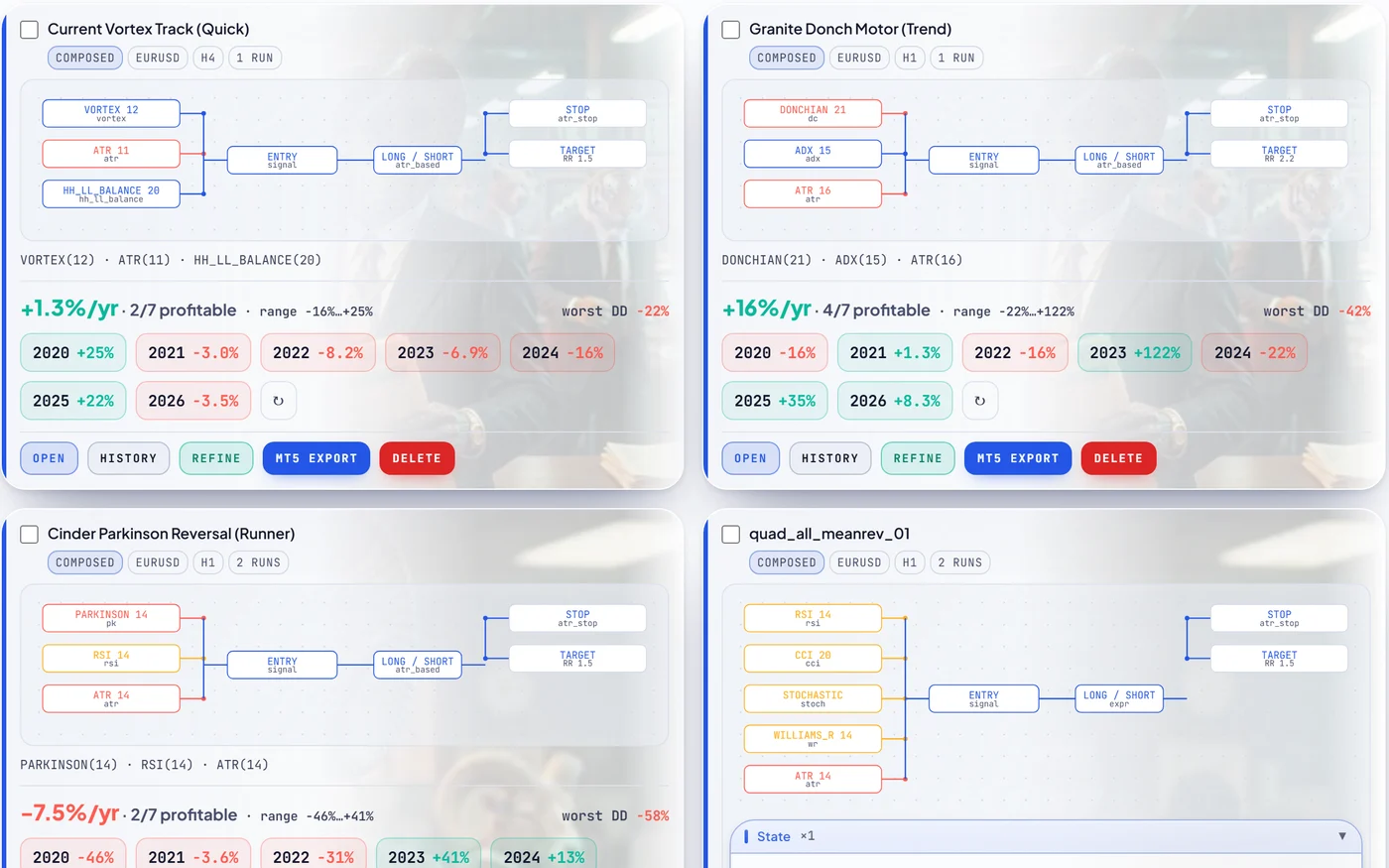
The composition step starts from 34 strategy archetypes grouped into 6 families — trend, momentum, mean reversion, breakout, volatility, regime, structure and sizing — rather than a blank canvas. You either set the dials by hand or describe the idea in plain English and let the AI knob tuner set them. Crucially, the dials take ranges rather than single values (lookback 8-60 bars, stop 1.5-4.0x ATR, reward:risk 1.5R-3.0R, risk per trade 1-2%), and a single run generates a batch of 10 to 50 candidates that are all backtested. That is a meaningfully better default than hand-tuning one configuration, because a batch across ranges shows you whether a parameter sits on a plateau or a spike — which is the difference between a robust rule and a curve fit. If you would rather start from something existing, the library holds around 20,000 named presets plus 74 tunable native strategy types, and every card shows its full wiring schematic and indicator list before you spend anything running it.
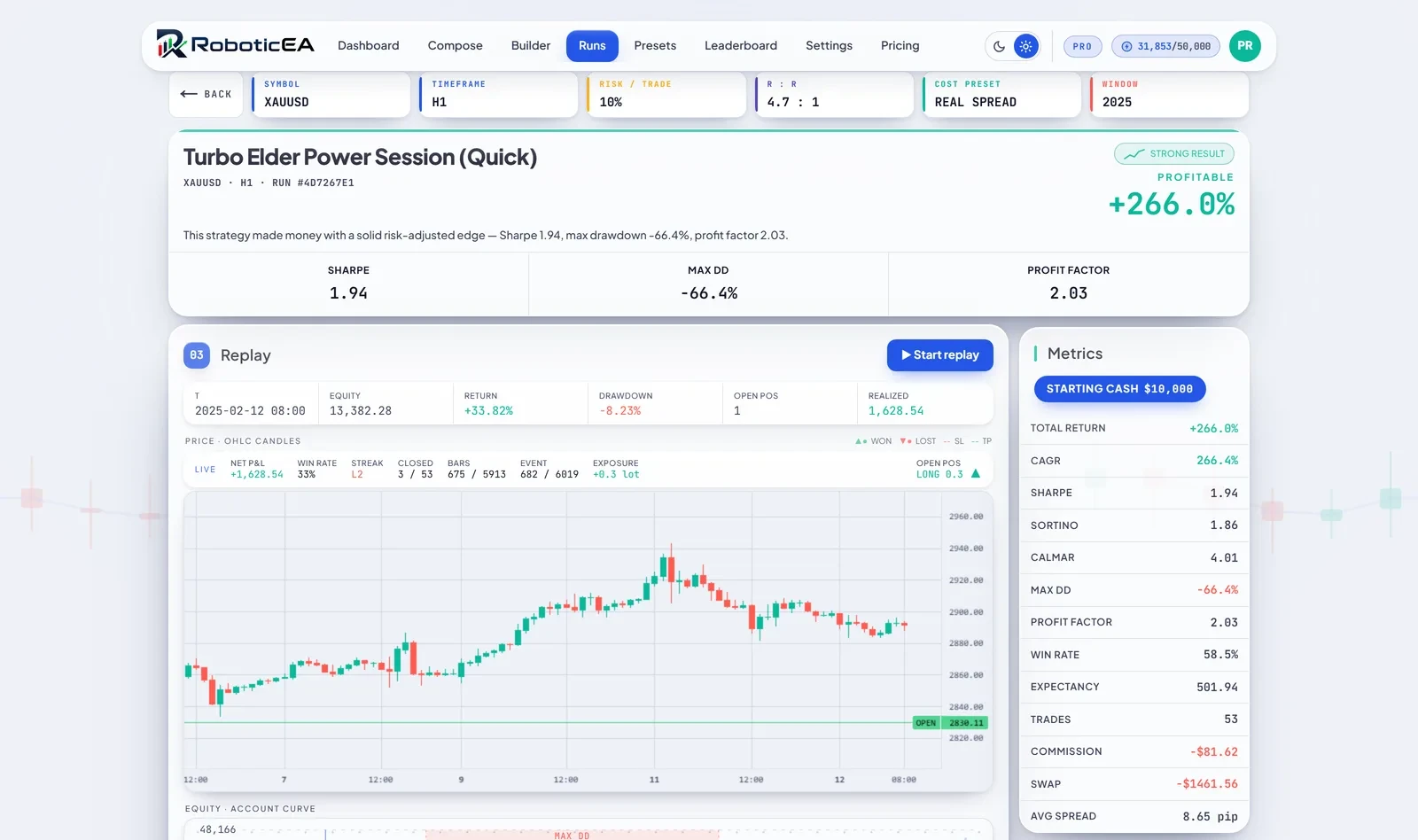
What sets the platform apart from the rest of the EA-builder market is what happens after the backtest. Every strategy runs from a fixed $10,000 account on real 2020-2026 data across 25 instruments and 6 timeframes, and the result reports commission, swap and average spread as charged amounts rather than assumptions — real spread is the default cost preset, not a frictionless zero. The metrics panel carries return, CAGR, Sharpe, Sortino, Calmar, max drawdown, profit factor, win rate, expectancy and trade count, and the plain-language verdict line at the top quotes the drawdown next to the return instead of burying it.
The per-year validation is the feature we would point to first. Rather than reporting one aggregate number, it re-runs the strategy on every year of its instrument as separate, replayable backtests and lays them out as a grid: mean percent per year, an 'N of 7 profitable' tally, the range from worst to best, the worst drawdown, and a green or red chip per year. It runs automatically on anything that clears your return threshold in a batch, which matters because manual validation is precisely the step an optimistic trader skips after seeing a good number. Two strategies that both look fine on 2025 are separated instantly when one shows 2 of 7 profitable and the other shows 4 of 7.
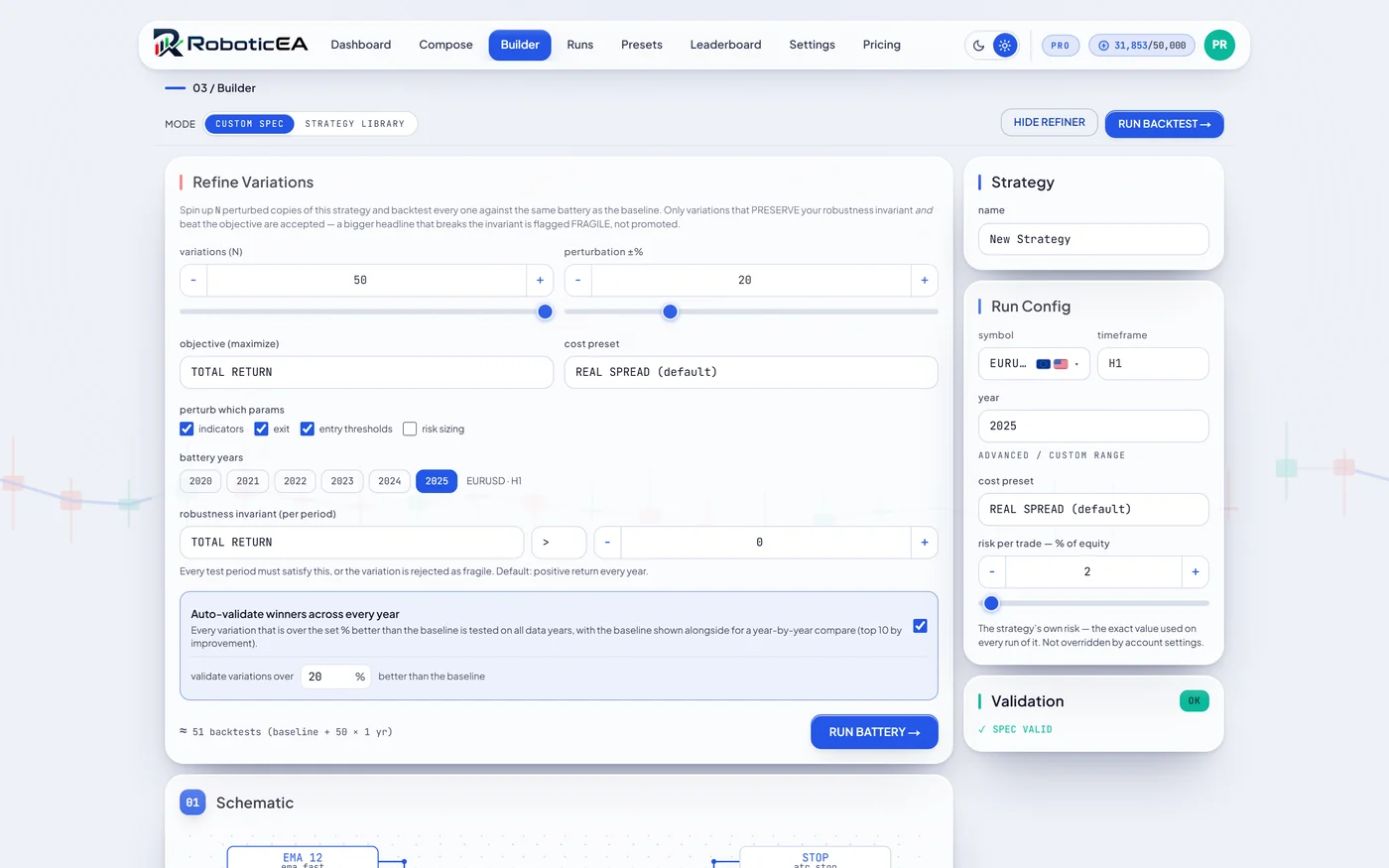
The variation refiner extends the same logic to robustness. It spins up to 50 perturbed copies of a strategy — nudging indicators, exits, entry thresholds or risk sizing by a chosen percentage — and tests every one against the same battery of years as the baseline. The part that makes this more than a parameter sweep is the robustness invariant: you set a condition every test period must satisfy, and a variation is only promoted if it beats the objective and preserves the invariant. A bigger headline number that breaks the invariant is flagged FRAGILE rather than promoted. A tool that deliberately refuses to reward its most impressive-looking result is a rare thing in this market.
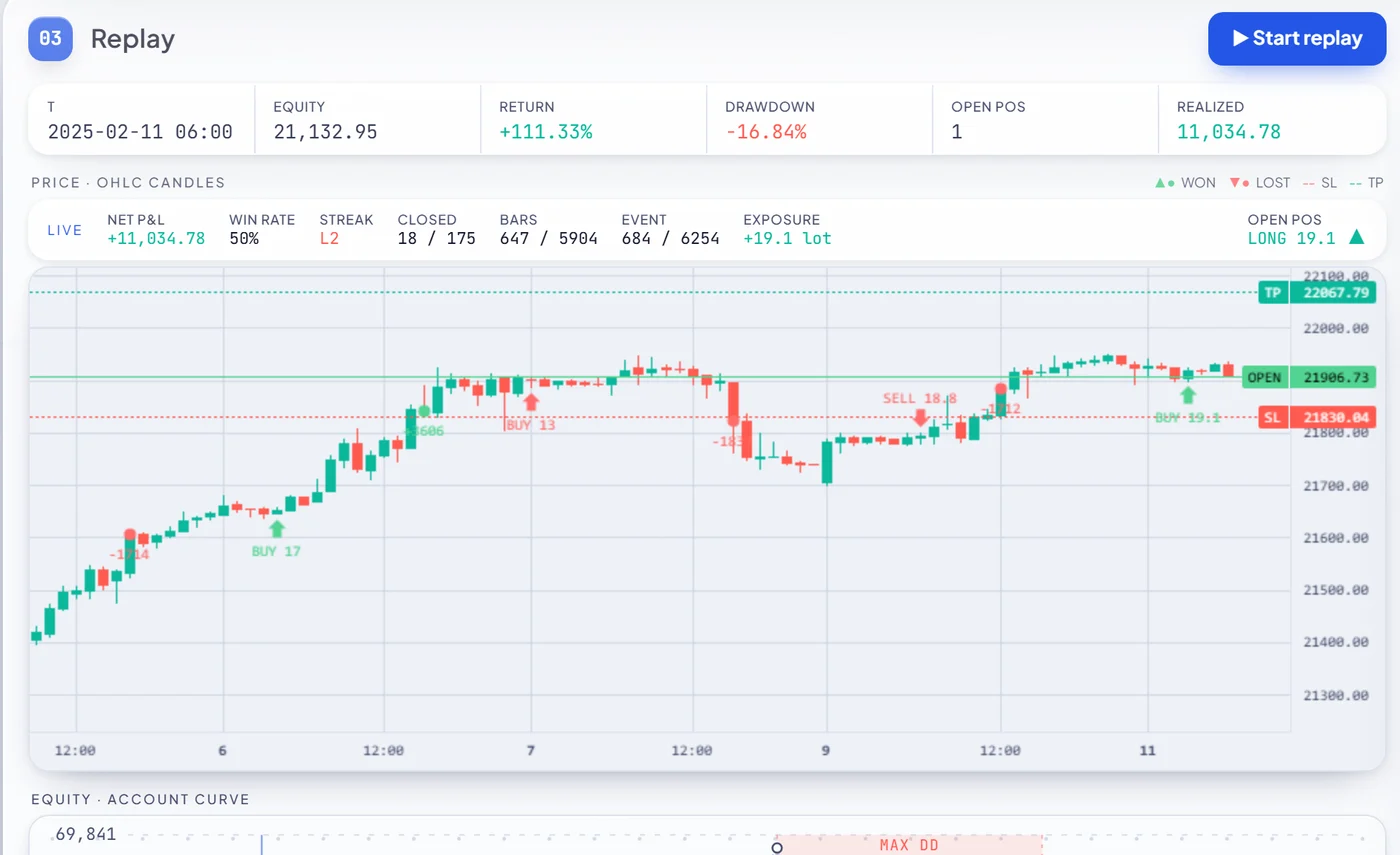
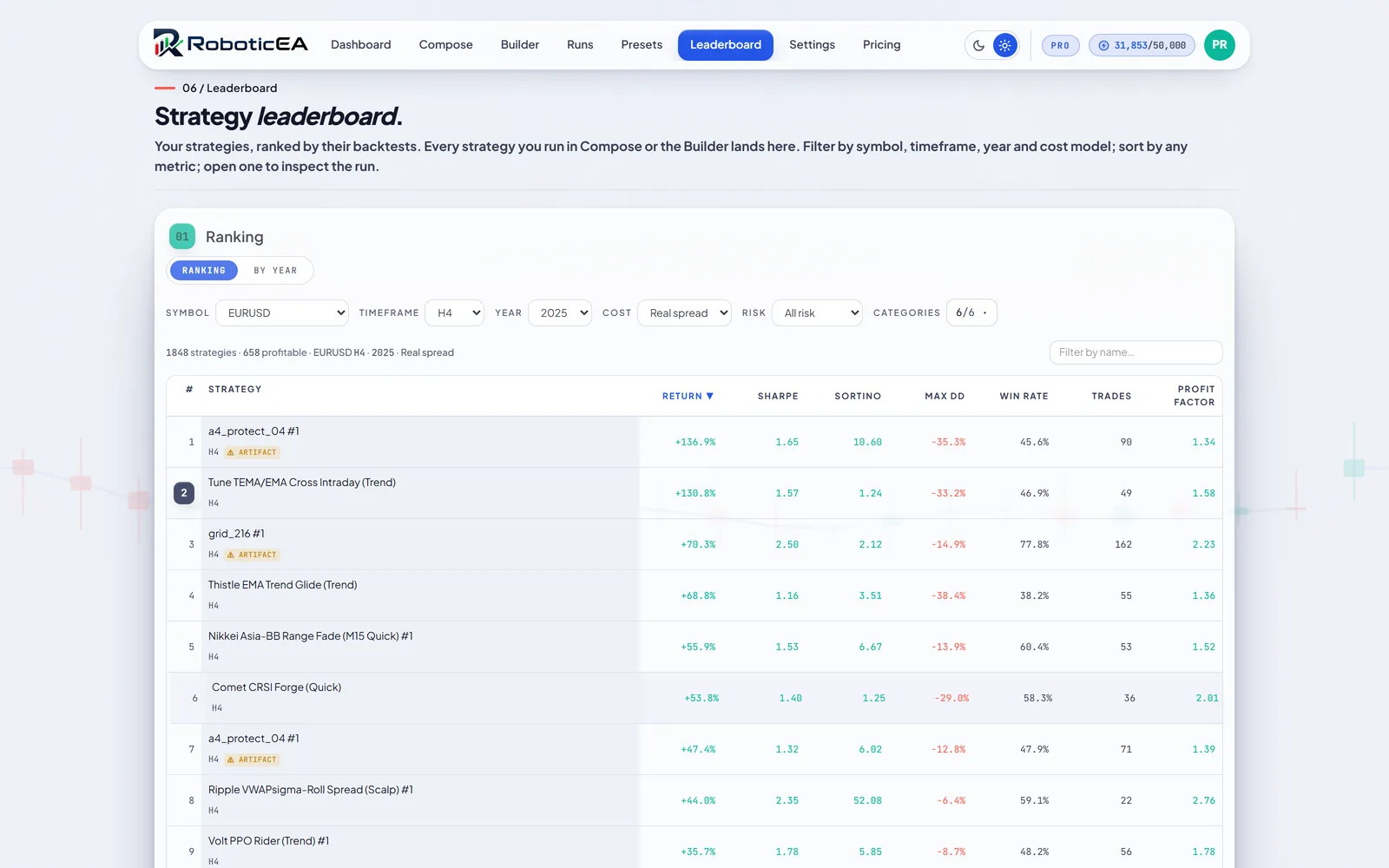
Trade replay covers the last gap. Press play and the strategy re-runs bar by bar on real OHLC candles with entry and exit markers, stop-loss and take-profit lines drawn on the chart, and the equity curve building underneath in sync, at 1x to 8x speed. Jump controls take you straight to the biggest win, the biggest loss or the start of the drawdown — which is the fastest way to find out what a robot's worst moment actually looked like. Every backtest you run also lands on a personal leaderboard automatically, filterable by symbol, timeframe, year, cost preset and risk, and sortable by any metric.
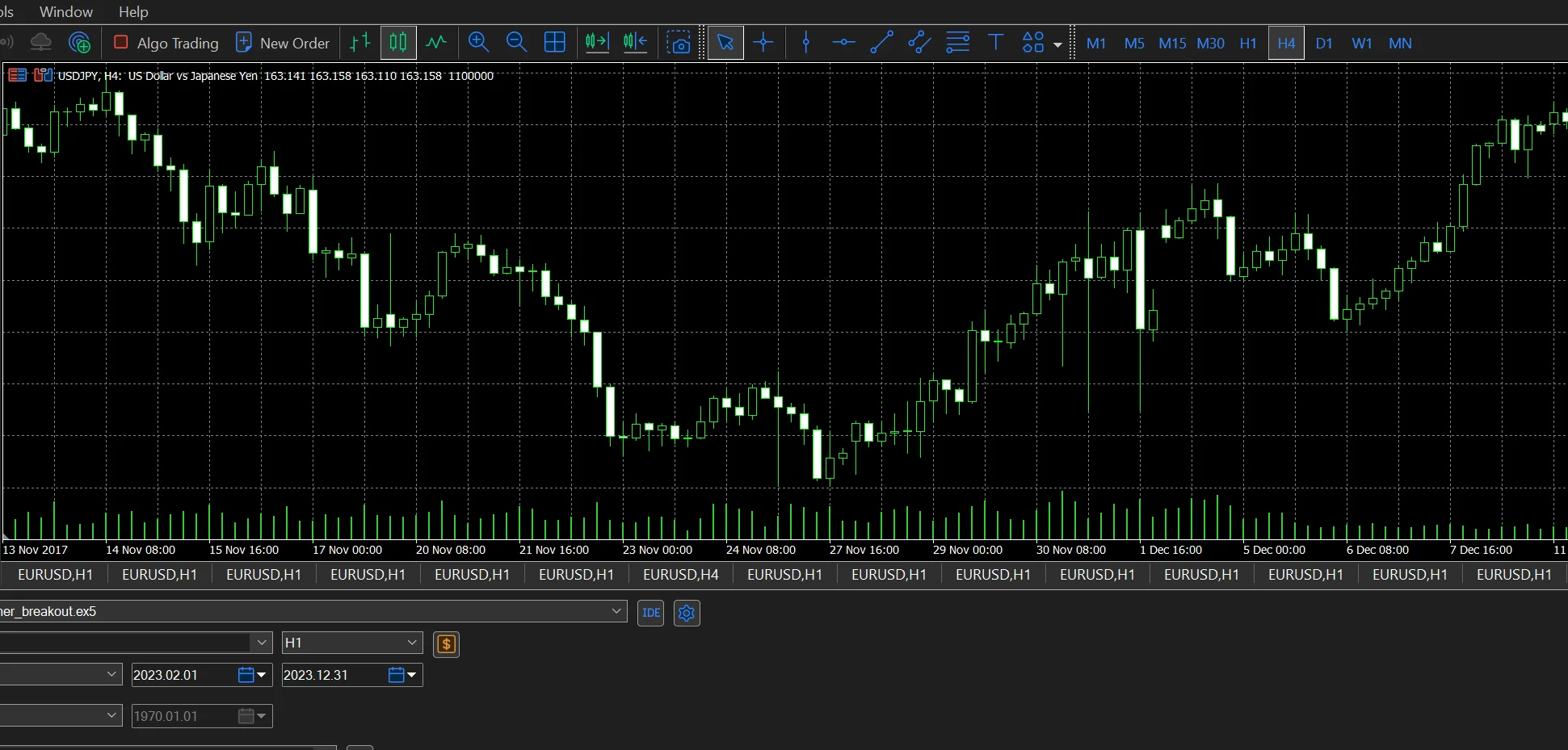
Export is where most builders in this category quietly disappoint, and RoboticEA does not. You get a readable .mq5 source file rather than a compiled .ex5 binary, with a source preview before download and an install guide covering the four steps: drop it in MQL5\Experts, open it in MetaEditor, compile with F7, attach it to a chart and enable AutoTrading. Account-level trading rules travel with it — flatten before weekend and avoid the 21:00-22:00 UTC rollover window are on by default and written into the exported EA as inputs, so the robot behaves in MetaTrader the way it did in the backtest. MQL5 export is available even on the free tier, which is unusual enough to be worth stating plainly.
One further point of credibility: the vendor publishes a parity study comparing its own C++ engine against MetaTrader 5 on 100 EURUSD strategies run over identical bars, and reports the gap rather than claiming there isn't one — 95% of strategies land within 5% on trade count, rising to 97% for ordinary entry/exit strategies, with a median trade-count gap of 0.3% and a median return gap of 1.1 percentage points. It also states outright that the MT5 tester will not reproduce the engine's numbers exactly, because your broker's feed, spreads and swaps are not the ones in the backtest. Publishing the size of your own disagreement with the reference implementation is not something we see often in this category.
- Feature breakdown→ — the compose, builder, validation, refiner, replay and export modules in detail
- How it works→ — the four-step workflow from idea to a compiled MetaTrader 5 EA
- Engine vs MetaTrader 5 parity study→ — 100 EURUSD strategies run through both engines, with the gap published
- Pricing and token model→ — free tier plus three paid plans, billed one token per backtest
- ✓34 strategy archetypes across 6 families, tuned by hand or by AI from a plain-English description
- ✓Batch generation: 10-50 candidate strategies per run, every one backtested
- ✓Around 20,000 named presets plus 74 tunable native strategy types
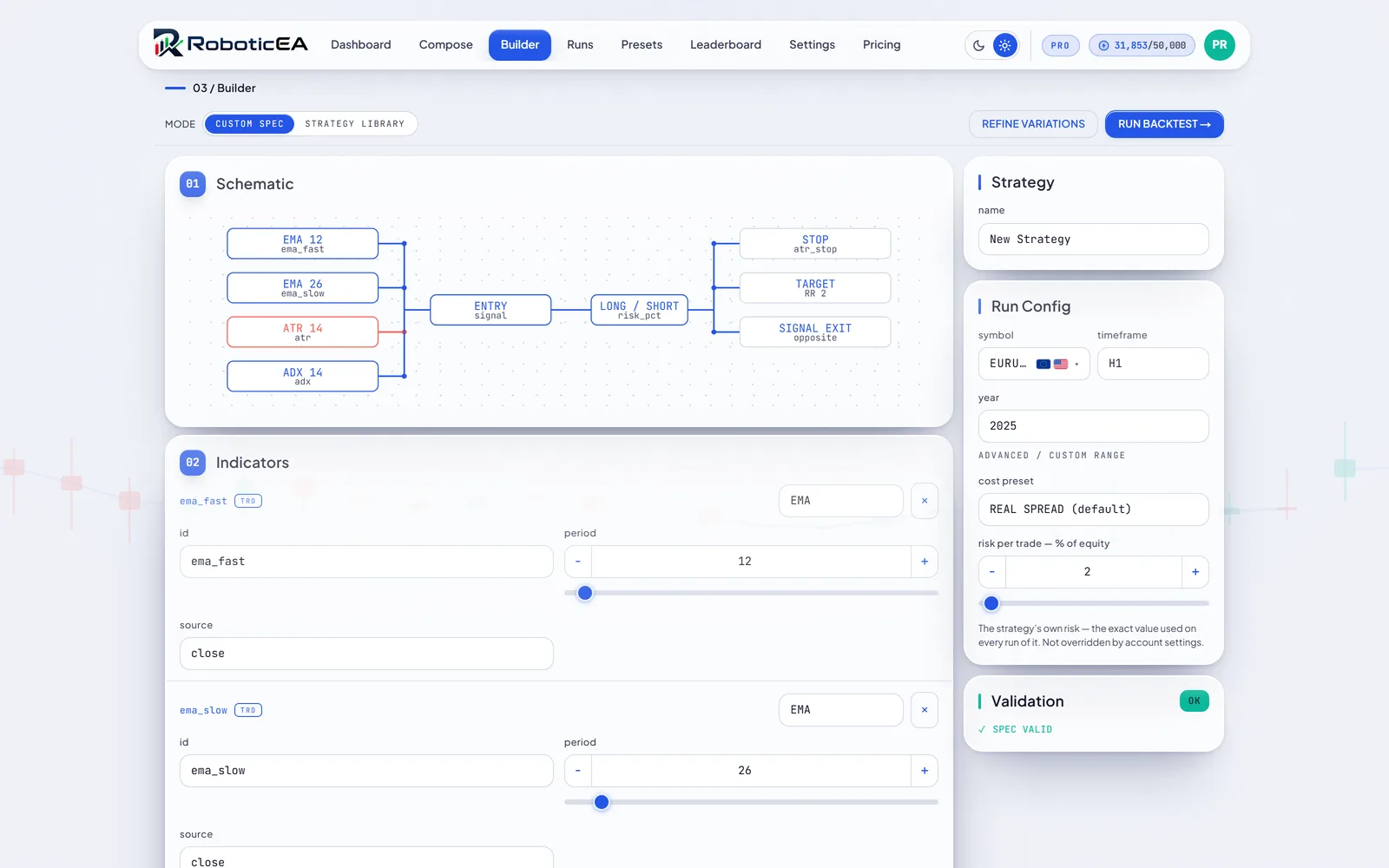
- ✓Visual schematic builder — every indicator, threshold, exit and sizing rule is an editable block
- ✓C++ backtest engine on real 2020-2026 data, 25 instruments across 6 timeframes
- ✓Fixed $10,000 starting account on every run, so results are directly comparable
- ✓Real costs charged and reported: commission, swap and average spread as line items
- ✓Per-year validation grid — every year re-run separately with an 'N of 7 profitable' tally and worst drawdown
- ✓Automatic validation of batch winners once they clear a return threshold
- ✓Variation refiner: up to 50 perturbed copies tested against a robustness invariant, fragile winners flagged not promoted
- ✓Bar-by-bar trade replay on real OHLC candles with SL/TP lines and a synced equity curve at 1x-8x
- ✓Automatic personal leaderboard, filterable by symbol, timeframe, year, cost preset and risk
- ✓MetaTrader 5 export as readable .mq5 source with a preview, not a compiled binary
- ✓Weekend-flatten and rollover-avoidance rules exported into the EA as inputs
- ✓Published engine-vs-MetaTrader-5 parity study with the disagreement quantified
- ✓MQL5 export included on the free tier
| Plan | Price | Includes |
|---|---|---|
| Free | $0 |
|
| Starter | $49/mo |
|
| ProPopular | $89/mo |
|
| Unlimited | $129/mo |
|
- +Per-year validation is built in and automatic — the single best defence against a robot that had one lucky year
- +The robustness invariant in the refiner actively rejects fragile high-scoring variations instead of promoting them
- +Real spread, commission and swap are the default and are reported as charged amounts, not hidden in assumptions
- +Exports readable .mq5 source you can audit and edit, rather than a sealed .ex5
- +Grid and martingale exist as explicitly labelled archetypes rather than undisclosed behaviour
- +Fixed $10,000 account on every run makes every result on the platform directly comparable
- +Publishes a parity study against MetaTrader 5 and quantifies its own disagreement
- +Genuinely usable free tier that includes MQL5 export and no card requirement
- −Steeper learning curve than a signal tool — you are expected to understand drawdown, profit factor and out-of-sample testing
- −Token-metered billing means heavy batch generation and multi-year validation consume allowance quickly
- −Single-year backtests on Starter; multi-year runs in one job need the Unlimited plan
- −Focused on MetaTrader 5 export — no MT4, cTrader or TradingView output
- −Backtesting and export only: it does not execute or manage live trades for you
- −Support is email-based; no live chat or phone
Traders who want to build and own their own expert advisor rather than rent a sealed one, and who care more about whether a strategy survives seven years of separate testing than about a single impressive backtest number. Particularly strong for MetaTrader 5 users who can code a little or not at all but want readable MQL5 source they can audit before it touches a live account.
RoboticEA is the most rigorous no-code EA builder we've tested, and its rigour is the point. Anyone can generate strategies; the hard part is throwing away the ones that only worked once, and this is the only tool in the category where per-year validation runs automatically on batch winners and the refiner will flag a higher-scoring variation as FRAGILE rather than promote it. Add real spread, commission and swap charged by default, a fixed $10,000 account so every result is comparable, bar-by-bar replay to see what the worst trade actually looked like, and export as readable .mq5 source rather than a sealed binary, and you have a platform that is unusually hard to fool yourself with. It asks more of the user than a signal service does, and the token metering adds up if you generate in bulk — but if you intend to run a robot on real money, this is the workflow you want in front of it. Second only to ChartSnipe overall, and first by some distance if what you need is a trading robot rather than chart analysis.